REVIEW · MALTA
Discover Valletta Half-Day Walking Tour
Book on Viator →Operated by V. Tabone Travel · Bookable on Viator
Valletta looks best when you walk it. This half-day group tour strings together the city’s key landmarks, viewpoints, and stories in a tight 3 hours 15 minutes, then releases you back into Valletta with time for your own picks.
Two stand-out reasons I like it: you get harbour views from the walls, and you’re guided through major architecture without having to figure out the route yourself.
I also like the practical style of this tour. You’ll see places like the Triton Fountain, City Gate, and St. John’s Co-Cathedral area, but you also get built-in breathing room to choose what you want to pay to enter (extra tickets are not included). That balance is good value at about $22.11 per person.
One thing to consider: most of the most famous interiors have separate admission (St. John’s Co-Cathedral, MUŻA, the Grandmaster’s Palace museum spaces, and Fort St Elmo’s National War Museum). If you want to do everything inside, your total day spend can rise quickly, and you only get limited time at St. John’s.
In This Review
- Key things that make this tour worth your time
- Price and logistics: what $22.11 really buys
- The start at The Phoenicia Malta: get oriented fast
- Triton Fountain and City Gate: the modernist moment that sets the tone
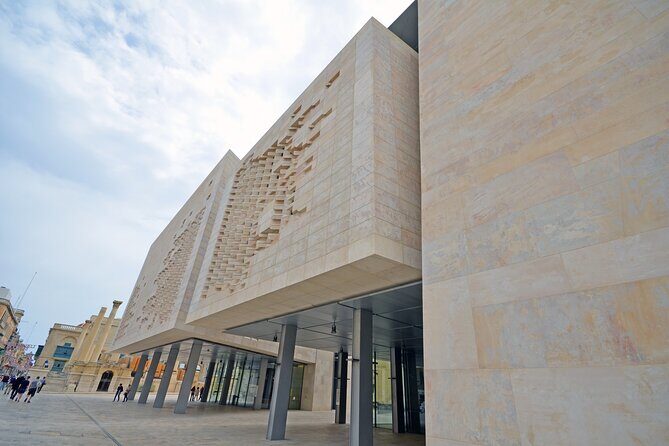
- Renzo Piano in action: New Parliament and the Royal Opera House site
- The New Parliament
- The Royal Opera House site
- Auberges on the hill: Castille, Italy, and what MUŻA means for you
- Auberge de Castille
- Auberge d’Italie and MUŻA
- Upper Barrakka Gardens: the harbour view stop that pays off
- Republic Street and St. John’s Co-Cathedral: 45 minutes to decide your priorities
- St. George Square and the Grandmaster’s Palace museum options
- Fort St Elmo: star fort, Great Siege role, and your National War Museum add-on
- Ending at Malta Experience: a 45-minute audio-visual history reset
- How long will you actually be walking?
- Guide quality can change the experience
- Should you book this Valletta half-day walking tour?
- FAQ
- Where does the tour start and what time?
- Where does the tour end?
- How long is the walking tour?
- Is the tour ticket mobile?
- Are admissions included?
- How much free time do I get at St. John’s Co-Cathedral?
- Is the Malta Experience show included?
- What languages are the guides available in?
- What’s the group size?
- Can I cancel for free?
Key things that make this tour worth your time
- 3 hours 15 minutes, then freedom: a guided loop now, free-choice Valletta afterward
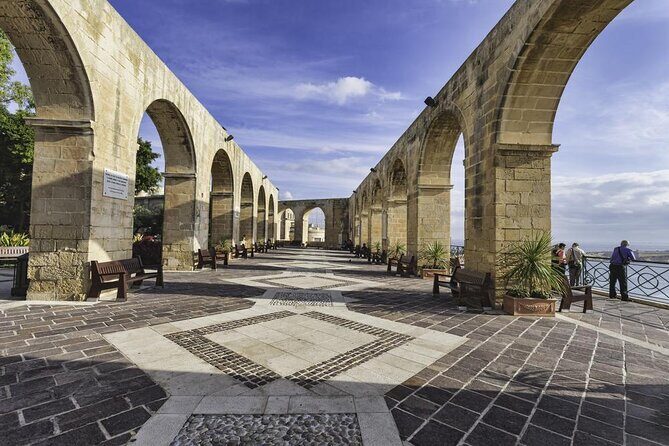
- Big-photo viewpoints included: Upper Barrakka Gardens gives a Grand Harbour view break
- Modern Malta meets older defenses: from the Triton Fountain to star forts at Fort St Elmo
- Renzo Piano design touchpoints: City Gate Project sites show up in multiple stops
- St. John’s Co-Cathedral break (45 minutes): enough time to plan your ticket and see what matters
- Licensed guide, small-ish groups (up to 50): you’re not stuck listening to a wall of noise
Price and logistics: what $22.11 really buys
At $22.11 per person, this is a true group-value option. You’re paying for a professional licensed guide and a structured walking route through Valletta’s best-known sights. That’s what keeps costs down: the tour covers the route and the context, while admissions are optional and priced separately.
Here’s the trade-off you should plan for. Several stops are quick exterior looks, and a few are inside-view or timed breaks where entry is on your own:
- St. John’s Co-Cathedral and Museum includes a 45-minute free time window, but the ticket is not included
- The Grandmaster’s Palace museum spaces are also not included
- Fort St Elmo’s National War Museum is not included
- You can choose to add MUŻA (Auberge d’Italie) and the Malta Experience show after the tour
Logistics are simple. There’s no hotel pickup, so you’ll start at The Phoenicia Malta (The Mall, Floriana) at 9:15am. The ending point is Malta Experience at St Elmo Bastions at 12:45pm, so you don’t have to wait for a bus to get back into the day.
One small practical note: some groups can run in a single language as booked, but occasionally it can be bilingual. If you’re hoping for lots of detail, this is where being prepared with a couple of questions helps.
You can also read our reviews of more walking tours in Malta
The start at The Phoenicia Malta: get oriented fast
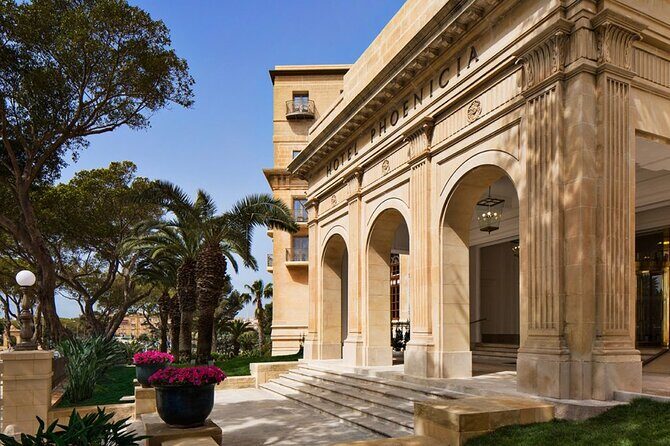
Your walk begins at The Phoenicia Malta on The Mall in Floriana. Even if you’re not familiar with Valletta yet, this is a good starting setup because the tour is designed around clear, timed landmarks and a single meeting point.
Since the tour begins at 9:15am and runs for about 3 hours 15 minutes, I’d treat it like a “get bearings, learn the big story” morning. You’ll cover a lot of ground, but not so fast that you’re constantly rushing to keep up.
Also, this one is built for real day plans. After the guided portion ends at 12:45pm, you can keep exploring on your own at whatever pace fits you—shopping on Republic Street, adding museum time, or just sitting with the views.
Triton Fountain and City Gate: the modernist moment that sets the tone
The tour kicks off with the Triton Fountain outside Valletta’s City Gate. It’s not just a pretty landmark—it’s described as one of Malta’s most important Modernist landmarks, first inaugurated in 1959 and restored in 2018. That timing matters because it signals something about Valletta: it’s not only medieval defenses and baroque churches. The city also updates itself.
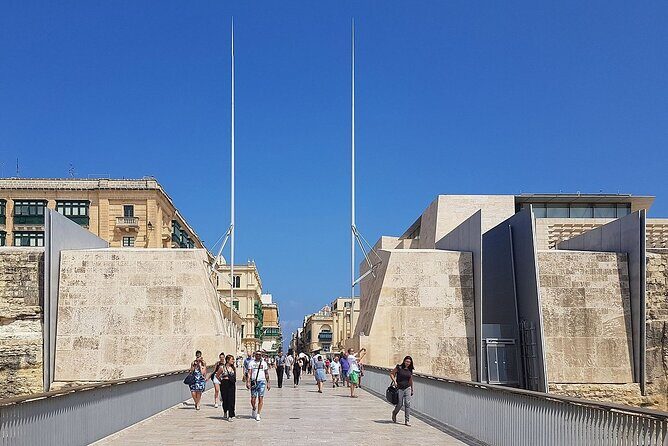
Then you move to Valletta City Gate in the Porta Reale Curtain, the curtain wall between St. James’ and St. John’s Bastions. A bridge spans the ditch, and the gate marks the start of Republic Street, Valletta’s main spine that runs toward Fort Saint Elmo.
A key detail you’ll likely hear: the present City Gate is the fifth one on this site, completed in 2014 to designs by Renzo Piano. That helps you understand why Valletta feels layered—old defense lines, new finishes, and a continuous city life on top of centuries of fortifications.
Renzo Piano in action: New Parliament and the Royal Opera House site
Two quick stops highlight a modern design theme—Renzo Piano shows up again and again in Valletta’s newer public buildings and restorations.
The New Parliament
The New Parliament building was constructed between 2011 and 2015, also part of the City Gate Project. It’s made as two connected blocks with bridges, and the structure is a steel frame clad in Gozitan limestone. You’ll hear a nice symbolic detail: it’s intended to represent honeycombs, echoing the name connection to Melite, linked to honey.
Even though you’re only there briefly, this stop is useful if you like seeing how a historic city handles modern governance. Valletta didn’t freeze in time—it keeps building, and the design language references Malta rather than ignoring it.
A few more Malta tours and experiences worth a look
The Royal Opera House site
Next comes the Royal Opera House site. The original opera house was designed by English architect Edward Middleton Barry and finished in 1866. Then came the harsh part: it took a direct aerial hit in 1942 during WWII.
Here’s why this stop is more than a sad footnote. The ruins were redesigned by Renzo Piano, and in 2013 it restarted functioning as a performance venue. It’s a strong reminder that destruction didn’t end the cultural story—Valletta rebuilt it.
Auberges on the hill: Castille, Italy, and what MUŻA means for you
As the tour climbs through central Valletta, you’ll hit multiple auberges—knight’s lodgings organized by language groups. Even when you’re just looking at the outside, this part helps you connect buildings to the political system that shaped the city.
Auberge de Castille
Auberge de Castille (Castille Palace) sits at the highest point of Valletta. Built in Baroque style in the 1740s under the magistracy of Manuel Pinto da Fonseca, it replaced an earlier building from 1574 that housed knights of the Order of Saint John from the langue of Castile, León, and Portugal.
Today it’s not a museum open to the public. The tour notes it houses the Office of the Prime Minister of Malta. That means it’s a “see and imagine” stop, not a “go inside and linger” stop—still worth it for the scale and setting.
Auberge d’Italie and MUŻA
Later you pass Auberge d’Italie, built in the late 16th century for knights from the langue of Italy. In 2018, it became MUŻA, the National Art Museum.
If you love art or want to spend your free time productively after the tour, this is a great anchor point. You’ll know exactly where MUŻA is because you already walked past the building during the route.
Upper Barrakka Gardens: the harbour view stop that pays off
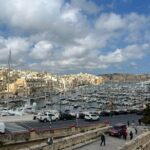
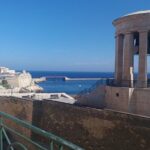
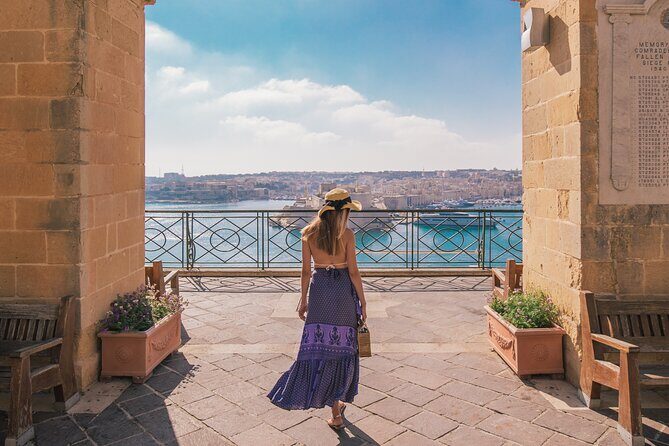
At Upper Barrakka Gardens, you get a chunk of free time—about 15 minutes—to enjoy the view over the Grand Harbour. The gardens sit on the upper tier of St. Peter and Paul Bastion, built in the 1560s, originally meant as recreation space for the knights.
This stop is one of the best values on the walk because it’s a payoff moment. You’ll look across:
- the Grand Harbour
- the Three Cities
- the shipyard and lower parts of Valletta
Even if the morning felt like a fast list of stops, the gardens give your brain a break and help you understand Valletta’s shape—high walls, steep streets, and water everywhere.
Republic Street and St. John’s Co-Cathedral: 45 minutes to decide your priorities
The tour includes 45 minutes of free time at St. John’s Co-Cathedral and Museum (entrance not included). This is where the walking tour becomes a personal choice.
During this window, you can:
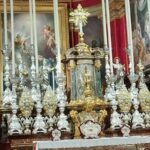
- purchase tickets to visit the Co-Cathedral and Museum, including the Caravaggio masterpieces in the Oratory
- see the Flemish tapestries
- check the church museum
- admire the marble inlaid floors
- use the multilingual audio guide included with admission
- grab a snack or relax nearby in Republic Square or nearby piazzas
- shop along Republic Street
This is also where I’d plan for your own style. If you’re a “must see one masterpiece” person, you can focus quickly. If you want a slower art-and-architecture hour, you’ll likely want to buy a ticket and pick a route inside with a priority list.
One fair caution: some people found the explanations basic, so if you care deeply about art history, be ready to skim labels inside or ask your guide what to look for before you go in. Also, your time is capped here, so arrive ready to choose.
St. George Square and the Grandmaster’s Palace museum options
From there you move into the heart of Valletta at St. George Square, also called Palace Square. It’s the largest and most prominent square, directly in front of the Grandmasters’ Palace.
This stop is short—about 5 minutes—but it matters because the square anchors the rest of what you’ll see. The palace sets the city’s power story, and the square is where major occasions were held.
Then comes the big building: Grandmaster’s Palace (also known as The Palace). It was built between the 16th and 18th centuries as the palace of the Grand Master who ruled Malta. It later served as the seat of the Parliament of Malta between 1921 and 2015.
Today it houses:
- the Office of the President of Malta
- Palace State Rooms and the Palace Armoury, which are open to the public as a museum
Admission isn’t included in the walking tour, but if you want an indoor political/ceremonial view after the tour ends, this is a logical place to pick up museum time.
Fort St Elmo: star fort, Great Siege role, and your National War Museum add-on
You’ll also reach Fort Saint Elmo (Fort St Elmo), a star fort on the seaward shore of the Sciberras Peninsula. It divides Marsamxett Harbour from Grand Harbour and helps command the entrances to both harbours, alongside Fort Tigné and Fort Ricasoli.
The fort’s headline role is its part in the Great Siege of Malta in 1565. Since 1975, part of the fort has housed the National War Museum.
This stop is helpful for two reasons:
- You get the defense context—how Valletta protected the harbours.
- You get a clean “end-of-walk” location because the tour finishes at Malta Experience right by the St Elmo Bastions area.
If you like military history, you might pair Fort St Elmo and the Malta Experience show on the same afternoon.
Ending at Malta Experience: a 45-minute audio-visual history reset
The guided tour ends at 12:45pm at the entrance of Malta Experience on St Elmo Bastions. You can buy tickets for the 45-minute multilingual audio-visual show at 13:00. It’s described as bringing Malta’s history throughout the centuries back to life.
There’s also time to grab a drink and snack while you look out over the Grand Harbour (not included). This is a great way to transition from the morning’s walking and “look at buildings” learning into a more story-driven wrap-up.
I like this ending approach for one reason: after you’ve seen the architecture, the show helps you connect the dots. It’s a lower-effort way to turn your morning into a coherent storyline.
How long will you actually be walking?
The duration is listed as about 3 hours 15 minutes. Stops are short (often around 5 minutes), with a couple of meaningful time blocks:
- Upper Barrakka Gardens: about 15 minutes for views
- St. John’s Co-Cathedral: 45 minutes free time (ticket purchase separate)
- The rest is guided movement and quick landmark context
Because it’s a group tour, your pace is steady, not leisurely. This is ideal if you want a “do a lot without planning” morning, then use the rest of the day for whichever museum you care about most.
Guide quality can change the experience
This tour is led by a professional licensed guide, in English, French, German, Italian, or Spanish as booked. That’s good news because you’ll get context at each stop instead of just reading plaques.
I’d still flag something practical: some write-ups praised guides like Josephine and Maria for making the history click and for ending with the Malta history movie at the end. Another write-up complained about poor explanations and a more basic level of detail, and there was mention of a bilingual setup.
So here’s my advice: if history detail is your main goal, come with a couple of questions about the periods you care about most (knights, WWII, or the design updates). And if you’re sensitive to how information is delivered when two languages are used, check that your booking lists the language you want.
Should you book this Valletta half-day walking tour?
Book it if you want:
- a smart first pass through Valletta’s most important landmarks
- a guided morning with time to do optional paid interiors
- harbour views without needing to plan them
- a clean finish at Malta Experience so you can decide what to add next
Skip it or adjust expectations if:
- you’re trying to check off every museum and you know those entrances cost extra
- you need a very deep, lecture-style history session in one sitting
- your schedule is tight right after 12:45pm (because you’ll likely want to choose what to do next on the spot)
My bottom line: this is an efficient way to learn the city’s map—City Gate to Fort St Elmo—while giving you the freedom to spend your money where you care most. If you like structure with choice, it fits Valletta perfectly.
FAQ
Where does the tour start and what time?
The tour starts at The Phoenicia Malta (The Mall, Floriana, Malta) at 9:15am.
Where does the tour end?
It ends at the Malta Experience entrance at St Elmo Bastions, Triq Il-Mediterran, Valletta at 12:45pm.
How long is the walking tour?
The duration is approximately 3 hours 15 minutes.
Is the tour ticket mobile?
Yes, the tour uses a mobile ticket.
Are admissions included?
No. The tour includes guided stops and free-time windows, but admission tickets are not included for places like St. John’s Co-Cathedral and Museum, MUŻA, the Grandmaster’s Palace museum spaces, and Fort St Elmo’s National War Museum.
How much free time do I get at St. John’s Co-Cathedral?
You get 45 minutes of free time at St. John’s Co-Cathedral and Museum. Entrance requires a separate ticket.
Is the Malta Experience show included?
The show is not included. The tour ends near Malta Experience, where you can buy tickets for the 45-minute multilingual audio-visual show at 13:00.
What languages are the guides available in?
Guides are available in English, French, German, Italian, or Spanish, depending on how it’s booked.
What’s the group size?
The tour has a maximum of 50 travelers.
Can I cancel for free?
Yes. Free cancellation is available up to 24 hours in advance for a full refund.